S1: Time management, including scheduling coaching sessions, and self-leadership to resolve conflicting priorities and ensure sufficient time for recordkeeping and other role activities
Managing time to allow for work and coaching
After reading about time management on this course, and watching Dave Crenshaw’s time management video, I developed a system so I could manage my work alongside my study. This works as follows:
- I created a Trello board with a list for each day of the week. On every Friday afternoon, I look at my diary for the week ahead. I map out all the meetings and slot them in as grey cards with time reserved. I then map out all additional time as green cards. This is available for focus work, management, coaching and my studies.
- Every day I need a minimum of 30 minutes to review my ‘gathering points’, places where I leave tasks to accumulate until this review. I add a card each day for this task.
- I then review my pool of tasks for the week ahead and allocate a time to work on them, leaving a little extra time for unexpected interruptions and tasks.
- I allocate 6 hours of purple cards to work on my apprenticeship.
This level of discipline means that when someone asks me to do a new task or have a meeting, I can easily see whether I have space in my diary, or whether something else would have to be moved to accommodate the new request.
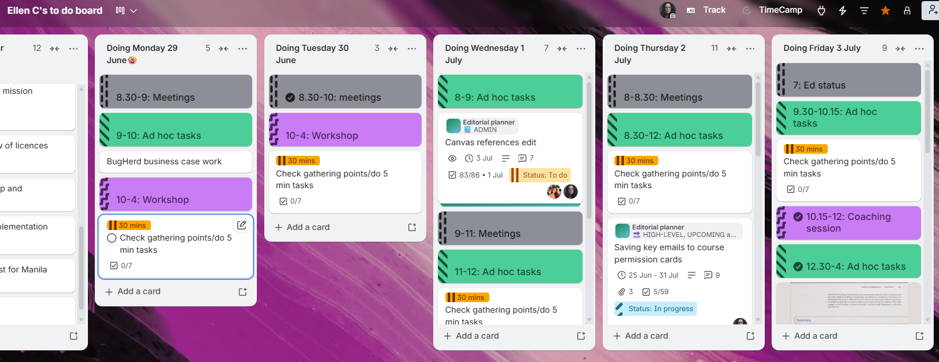
Screenshot of my Trello to do board
Scheduling and preparation for coaching
It is important to balance my apprenticeship work with my other responsibilities. I found this relatively easy before starting coaching, as I dedicated two afternoons for apprenticeship study. I know many people choose one focused day each week, but I manage a team based in Manila and our working hours only overlap between 9-11am each day, so I wanted to work every morning to maximise this time with my team. Therefore, afternoons are better suited to my specific working arrangements.
Once coaching began, of course, I needed a more flexible arrangement as appointments had to be organised around times that were suitable both for me and my clients. I still try to use afternoons, to allow me to be available for my team.
I find that coaching requires energy and focus, and so it’s important not to hold the sessions close together. With this in mind, I initially held only one coaching session per day. Early in my coaching practice, I learned a lesson in scheduling time before and after the session. With client 2 session 1, I booked a meeting room at the office. However, I only booked it from the start of our session, and the meeting beforehand overran by several minutes (I could see from the title that it was someone’s appraisal so didn’t feel it was appropriate to interrupt).
Protected time before and after
Since this episode, I have booked a meeting room from 15 minutes before to 30 minutes after the coaching session. This has two benefits.
- I know that if the previous meeting overruns it still won’t impact the coaching time.
- I have time to set up the room, check the aircon or heating, and prepare myself mentally for the session. The time at the end allows me to overrun slightly if that’s helpful (especially as I am learning), and to write up my reflections and keep records. I have found this approach to be beneficial to me and my clients.
I also make sure I always book a meeting room for coaching, even if it’s online. It means I always have a dedicated space with natural light, and having done this consistently, I now find it easier to get into coaching mode by entering a familiar environment each time I am coaching.
At times this isn’t possible, and I coach from my home office, but I still block out my diary for 15 minutes beforehand and 30 minutes afterwards.
My preparation for coaching consists of:
- reviewing my notes from the previous session and reminding myself of both my client’s goals and my own development goals
- ensuring the room is set up with two chairs around the corner of a table, no-one looking into the sunlight and a glass of water for me and my client.
- sitting with my feet flat on the floor and breathing slowly, bringing my awareness to the moment and my focus to the session that’s about to begin.
This is excellent for being present for my client.
My time after the coaching is spent:
- writing my reflections of the session
- asking Copilot to help me notice areas for growth
- creating a summary and starting point for the next session.
Leaving time really helps me to learn and focus on how I can help my clients. However, it does mean that each coaching session is nearly 2 hours in my diary. I have discovered that having 2 or 3 of these in different afternoons during the week leaves little time for focused work for my job. So, after initially only holding one coaching session per day, I moved to blocking out whole afternoons to run two back-to-back sessions, with one hour in-between for reflection and preparation.
2pm: Prepare
2.15-3.15pm: Coaching
3.15-3.45pm: Reflection
3.45-4pm: Prepare
4-5pm: Coaching
5-5.30pm: Reflection
I found this was a better way to balance work and coaching, as I still left enough time to prepare and reflect, but had other afternoons free to focus on my job.
Dealing with scheduling conflicts
I have identified my priorities as part of this training. My highest priority is to other people. Therefore, once scheduled, I will not move a coaching session or a 1-1 meeting with one of my team due to a conflict, unless they are in exceptional circumstances.
I keep my diary up-to-date, so my colleagues can see this is reserved time. If I am invited to attend a meeting at a time reserved for coaching, I will decline the meeting and catch up later, or ask for it to be reorganised.
My planning system means it’s easy for me to identify when I will have more work than time, and allows me to delegate tasks or reprioritise with support from my manager.
Conclusion
Protecting and prioritising my coaching sessions increases psychological safety for my clients. By being consistent, they know they are valued and prioritised, and I am seen to be acting as set out in our contract.
Predictability and reliability can increase my clients’ engagement with the coaching process, as it allows them to prepare effectively for the sessions, and to set and review goals at predetermined times.