B1: Committed to self-development, including self-reflection, gathering information on the effectiveness of their own practice, producing personal development plans and receiving coach supervision.
Self-development
Self-development is an essential tool for life. It is based on the principles of continuous learning including setting clear goals, self-awareness and self-discipline including emotional regulation and persistence.
By finding a balance of these three areas, I can develop a “growth mindset” (Dweck, 2006) which allows me to grow as a coach, a manager and as a leader.
As Broadwell’s framework highlights (Broadwell, 1969), self-development allows a person to move from unconscious incompetence to unconscious competence (via conscious incompetence and conscious competence). Throughout this programme, I have used research, experience and reflection to reveal to me what I don’t know. This has helped me move towards using new skills and knowledge more easily and naturally.
Self-development works in three key areas:
- Research: Build knowledge to inform my coaching practice, from theories, frameworks, teaching and feedback from others (mentors, peers, clients, direct reports).
- Practice: Skills developed through my own coaching practice.
- Reflection: Analyse myself and my practice to allow me to understand and manage myself better, which in turn will strengthen key coaching skills such as understanding emotions, communication, visualising goals and leading people.
My research is evidenced through my work on this apprenticeship and my off-the-job training sheet, and my practice is evidenced through the 50 hours of coaching I have completed, as well as attendance at all three workshops.
The following section provides evidence for the development of my reflective practice.
Self-awareness: a baseline
The starting point for self-development is self-awareness – appreciating where I am now, so I know which areas I can develop in.
In Module 1 we carried out several exercises to help us become more self-aware as we started our journey as coaches.
- I completed a self-evaluation and also asked a colleague to complete it. This was a really helpful exercise which highlighted some interesting points about the challenges I might have in coaching and how I can think about overcoming them during my training (see Supporting evidence: Self-evaluation activity). We concluded that I may struggle with a preference to be nice rather than probe further and take people into uncomfortable topics and questions. This has been incorporated into my PDP (see below).
- I completed a Johari window, where I looked at my self-image, projected image and received image (see Supporting evidence: Johari window exercise). I asked for feedback from seven people, including people close to me, and people I’ve only known for a little while, both from work and at home. Reflecting on this exercise, I discovered that my colleagues and family see me in a similar way as I see myself with ‘trustworthy’, ‘organised’, ‘logical’ and ‘helpful’ as words I used to describe myself and that at least two other people used for me. I found this a reassuring start to my self-reflection because it suggests there are not large gaps between the way I view myself and the way others view me.
- I created a SWOT analysis for myself (see Supporting evidence: SWOT analysis). I identified two key opportunities “Leading meetings and keeping people to agendas and agreed timings would be good to practice speaking in front of others and leading in group settings” and “Get feedback from my direct reports about how I am doing in my role and what I could do differently. I have been reluctant to do this as I feel awkward about it.” These opportunities have fed directly into my development plan (see below).
Growth during my apprenticeship study
As I complete my apprenticeship, it’s useful to reflect on where I began and how I have developed over these twelve months.
The self-evaluation activity was useful and turned out to be accurate. As I developed as a coach and reflected on my sessions, I noticed I was more comfortable with listening and leaving space than with intervening to challenge assumptions or recontracting to contain the scope of the session. The self-evaluation exercise enabled me to notice and acknowledge this early in my development, seek advice from my coach mentor and actively seek to improve holding the ‘shape’ of the session for my clients, without leading their thinking. I have learnt that whilst listening and leaving space is also a type of challenge, if the client is given too much space to think without the correct framing to contain their train of thought, the coaching sessions are not as effective (Supporting evidence: Reflection on session VK S4).
The SWOT analysis enabled me to think about getting more exposure in meetings and practice leading and shaping conversations. During my quarterly review meeting on 16 June 2026, my manager observed that “Ellen is increasingly skilled at guiding conversations, pulling out relevant detail, and facilitating meetings. She noted Ellen’s growing confidence and ability to navigate discussions without steering them towards her own agenda.”
Evaluating coaching practice to inform self-development
Self-reflection is the structured practice of examining thoughts, behaviours and emotions to make meaning of an experience. Reflective practice is important because as a coach I work in 1-1 settings with my clients. Whilst I have resources such as coach mentors and supervisors, I need to have a disciplined way of reflecting on my sessions, thinking about the 5W1H – Who, What, When, Where, Why, How – to make sense of and learn from the experience, and take away action points for my future coaching and work.
Doing this consistently and regularly is a very important part of learning to become a coach and continuing to grow as a coach beyond qualification. As such, it has been an important habit to establish early in my practice as a coach. “The self is the main vehicle through which we see others”.
Record-keeping and reflection
My notetaking and reflection is quite detailed and I have created prompts and templates to help with this. I use OneNote.
For each client I have a section in OneNote, stored under client number and the month the coaching began. Within the section I have pages for each session, in which I only include the client’s initials, and general pages to keep notes on reflections on the coaching relationship and the client’s goals and actions after each session.
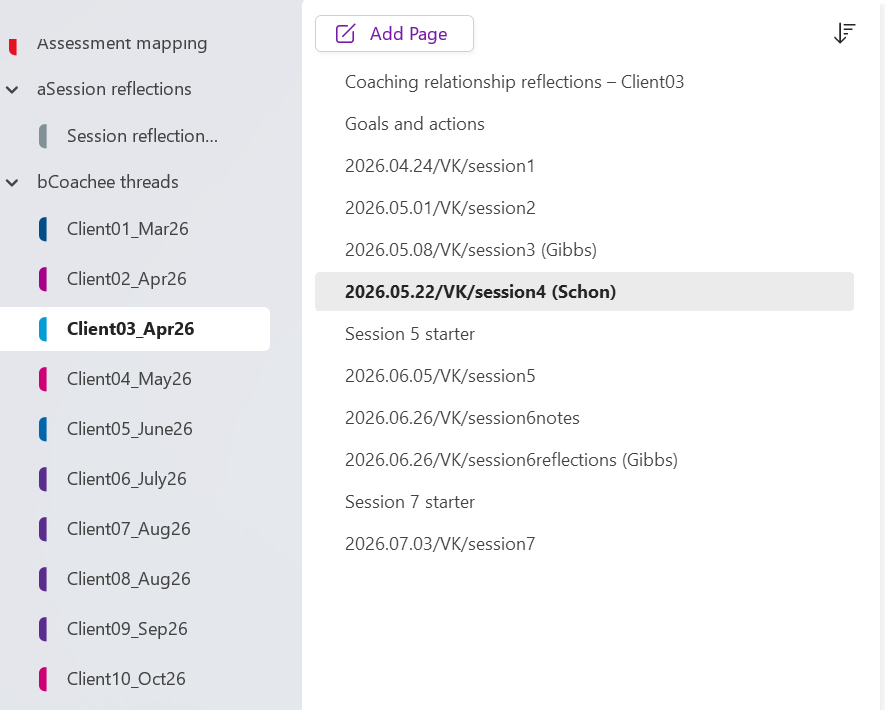
For my reflections, I have created templates and a set of rules to help me try various reflective models.
The rules are:
- Use Gibbs for discovery session, session 3 and session 6 (because this encourages a more in-depth analysis, which is helpful at key stages in the coaching journey).
- Use my general template (see below) for most of the others, unless:
- I have a lot of reflections about my role in the session (Schön) (because this enables me to think deeply about what I was thinking during the session and how I can continue to learn from it after the session).
- I need to think about self-awareness (Rolfe) (because it helps me to think beyond what happened to why it happened and what learnings can be taken from it).
- I’ve had feedback from client or colleagues (Brookfield) (because this allows me to analyse feedback from different lenses and help me better understand what is going on for me).
Reflective model templates
This is a screenshot of my general reflective template
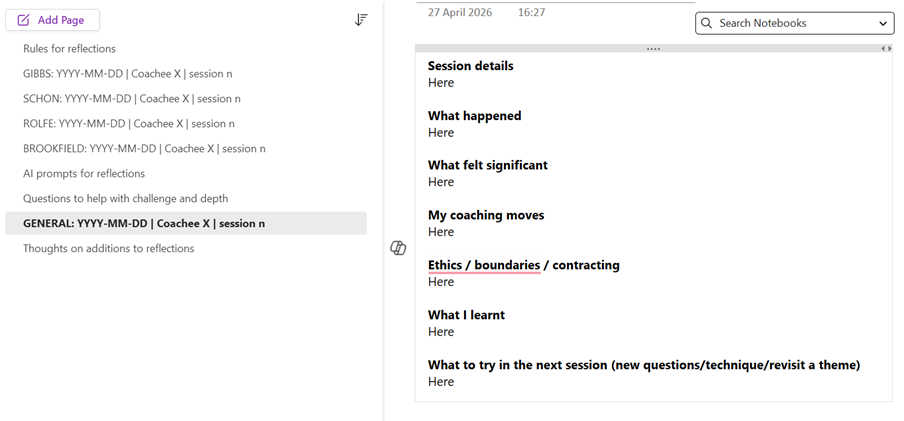
See Supporting evidence: Selections of reflections for examples of how I use these reflective templates.
As well as using these reflective models myself, I have also shared the templates with my team and encourage them to reflect on their growth and work between 1-1 meetings, so we can have coaching-style conversations and to support them in becoming curious and self-sufficient.
After every even-numbered session, I also update a page on ‘coaching relationship reflections’. This has prompts to think about:
- How this coachee seems to think and work
- What I notice about me with this coachee
- Patterns emerging across sessions
- What I’m holding lightly/parking.
I have found this particularly enlightening as it allows me to acknowledge the differences in my relationship with different people, and think about how I can manage myself and my assumptions or reactions for future sessions.
An example, from client 2 is:
“How this coachee seems to think and work
Very self-aware and applies herself to the coaching. Comes with a goals and outcome-based mindset of wanting to improve and wanting to get the most out of these sessions.
What I notice about me with this coachee
I spend a lot of time listening. I am a colleague and so know some of the people and situations mentioned. This sometimes leads me to thinking about the solution or her possible next steps. It takes a lot of awareness to physically relax and mentally switch off from advising so I can remain neutral.
Patterns emerging across sessions
Proactive approach means that despite being weekly, she has taken action and wants to discuss learnings from previous session.
Themes of lack of support, lack of confidence in delivering her message and managing conversations, vulnerability at work.
She’s acknowledging her growth and repeats back key phrases she has learnt, such as ‘approach with curiosity’.
What I’m holding lightly/parking
We’ve touched on, but haven’t examined closely, her relationship with her manager. If the topic comes up again, I will recontract to see if it’s something she would like to discuss further.”
Next session starter notes
As I have gained more experience, I have also started creating a next session starter page where I record any questions I might like to try or themes I would like to revisit. I use these notes to prepare for my next session.
This is particularly helpful to me as I coach more people. It means I have a meaningful prompt to help prepare for the next session, and allows me to bring in themes from across sessions.
Coach supervision
Throughout my apprenticeship I received regular supervision sessions with my coach mentor. I used the time to discuss my reactions to coaching and analyse what I can learn to help me develop as a coach.
For example, in my third progress review meeting it was noted “Ellen also reflected on her own confidence and the impact of working with clients who are different from herself, including cultural and gender differences.”
I am actively seeking coach supervision within my organisation to provide support once I have qualified.
Use of AI for reflecting
I think it’s important to do my own reflections first, so I can record my thoughts and learnings without outside influence. However, with permission from my clients, I also transcribe the sessions and I ask Copilot to help analyse the sessions and suggest areas where I could have challenged better, or to highlight where I asked closed questions. I find the insights from Copilot to be invaluable and I always leave time to do this analysis within 24 hours of the coaching session.
Before I started, I checked the privacy settings of our Copilot enterprise licence. Transcripts and AI conversations are stored locally on my drive and no-one else has access to these. I download the transcripts to my local drive so that only I have access to these. I use just the client’s initials to protect their identity.
Below is the main prompt I used for every session in my first six months, with particular emphasis on providing challenge as I know that is an area I would like to grow in:
“I am an apprentice coach. This was the Nth coaching session with this client. I would like some feedback on the following items, please. 1. What percentage of time was the coachee talking compared to the coach? 2. Did the coach use any closed questions? 3. Did the coach offer advice, and if so, where is this in the transcript? 4. What did the coach do well? 5. Which question seemed to open up the conversation the most? 6. What could the coach have done differently to help the coachee dive deeper into their thoughts? 7. Were there any opportunities to challenge?”
After six months, I added on additional questions
“8. What coaching models did I use? 9. What coaching techniques did I use?”
This helped me identify which models and techniques I used, and allowed me to see what my natural preference has been, and where I have succeeded in trying new things.
I also use Copilot to help me notice patterns across sessions. One prompt I have used is:
“How does this session compare to the first 3 sessions with the same client? In which ways am I growing as a coach? How is my client growing as a result? In which ways am I stagnating and doing the same things again? Is my client revisiting the same material? What themes does my client have and have they changed over time?”
I save all my prompts so I can revisit them with future clients, to help me to notice things I haven’t recorded in my own reflections.
See Supporting evidence: Example of AI feedback
Benefits of leaving time for reflection
Taking time to reflect gives me insight into my client’s thinking, allows me to assess my coaching and then set out my starting point for the next session. I revisit these notes to prepare for the following coaching session and as an opener. For example, “In the last session, we talked about X and Y. What’s changed for you since then?”
See my section on S1 about protecting time before and after coaching for a longer discussion on how I protect my time for reflection.
Personal development plans
The second stage is converting observations into actions. It is essential to ensure that reflections are not just passive. Using the insights from all the tools, feedback and research, I was able to use the self-awareness and reflective practice to create a set of goals and targets linked to the KSBs of this coaching course.
Ongoing research and education
- The foundations of my research and education have been the learning from the programme, including reading about and testing the GROW model, active listening, techniques and tools such as CBT, neurolinguistic programming and solutions-focused coaching. I have also established and refined my approach to chemistry sessions, contracting and ending coaching relationships.
- I discussed discovery sessions with my coach mentor in our quarterly review meeting on 10 March, in preparation for my first session the following week, and practised during my first workshop. Over time I have developed and refined my own bulleted list of items to cover in the discovery session (see Supporting evidence: Discovery questions).
- I have also read Time to Think by Nancy Kline, watched videos of coaching sessions and listened to episodes from a wide range of coaching podcasts. This helps me to evaluate what good coaching looks like and assess how my own behaviours align with established best practice. It also enables me to think about the difference between a beginner and an established coach, looking at where I might want to be in a year or two (or more) (see Supporting evidence: OTJT)
My own personal development plan (PDP)
- I have structured my PDP by relating goals to the Knowledge, Skills and Behaviours (KSBs) of this course. I have made sure I had a breadth of goals to cover different areas I want to grow in, and I set out next steps, what I plan to achieve and how to overcome obstacles.
- I developed goals as I worked through the learning content and coaching practice. New goals emerged and developed out of my learning and practice.
- My PDP has been a live working document. I developed a discipline during this apprenticeship that every six weeks, before my review meeting, I reviewed my PDP actions, updated my progress notes and revised and added goals where needed. I plan to continue this beyond this course by maintaining and reviewing a PDP before my regular meetings with my internal coach supervisor.
- By regularly reviewing and developing the plan, it remained a live document which I used to notice and record my progress as well as be reminded of the commitments I had made to my personal development.
- Making progress on my objectives allowed me to notice how I developed as a coach. For example, the task ‘To reflect on my strengths and weaknesses in structuring coaching sessions so that there is a balance between listening and making time for reflecting on the past and present, and looking forward to solutions and actions, to be carried out after coaching sessions.” I noted when I achieved this in July 2026 that “My experience of contracting and recontracting has led to me feeling more confident in naming and shaping the process of coaching. I have a strict and productive habit of reflection after coaching sessions, which has been hugely helpful in growing this.”
- See Supporting evidence: Ellen Collier PDP
Conclusion
Through structured self‑reflection, research, feedback gathering and the consistent use of a PDP, I am actively building my capability as a coach. This has enabled me to analyse my present state, understand where I want to grow and identify the actions I would like to take. This process is ongoing and iterative, and my reflective prompts, session templates and PDP have all developed and improved as I have progressed through this programme.
In particular, I have come to enjoy and value the time I spend reflecting after each coaching session, as it helps me better understand my client, notice myself and my reaction to the coaching relationship and then identify how I would like to use this to inform the future, both in the individual coaching relationship and more generally as a coach.